Sunday, May 5, 2013

Video Game Turns Meaning of Freedom and Slavery on Head


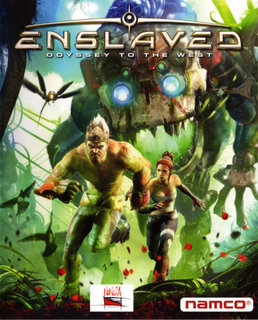
Enslaved: Odyssey to the West, published by Namco Bandai, and developed by Ninja Theory, is a video game that has moved me in a way few other video games ever have. I was expecting a good story, gorgeous landscapes, and intense melee combat with animal-like robots, but I never expected to be confronted with the philosophical issue of what freedom and slavery really are.

The central protagonist of this story, a nameless wanderer who goes by the nickname Monkey, doesn't have any responsibilities in life. He travels the lush post-apocalyptic America, wherever he “can find food and fuel,” as he describes to Trip, a woman that she encounters on a ship upon which they, and many other individuals, are imprisoned. Trip straps to his head an electronic headband that will kill him unless he does what she says, and keeps her alive as she seeks out her home. By a camp fire at night, Trip asks Monkey where he will go after she removes the headband, besides “breaking [her] neck,” she says. After a short silence, Monkey says, “wherever.” He has no direction in his life. No purpose.

SPOILERS: This is a stark contrast to the people whose minds are in the computer simulation of life before the “Great War,” which is what the man who calls himself Pyramid names it. According to him, he is not enslaving people, but “rescuing them from the wasteland,” by attaching their minds to this simulation. “They have jobs. They have marriages. They bring up their children. Their children go to schools . . . your world is a wasteland, in which you fight to survive. Pyramid is a world in which you can live.” Are the people of Pyramid really free? Certainly, they are free from having to wander the post-apocalyptic Earth, in which “you fight to survive.” In Pyramid’s simulated world, they have something to live for.

This is why Monkey chooses to remain enslaved to Trip, when she voluntarily deactivates Monkey’s headband on the eve of their final assault on the slaver ships’ central base. Trip tells him, “I’m not going to control you anymore.” Monkey asks if he is free to go, and she tells him, “If that’s what you want.” 

To this, Monkey bluntly replies, “Turn it back on.”

Monkey never had any direction in his life other than survival before Trip found him. He knows what life he would go back to if he is freed. Monkey gets something out of his captivity that he doesn’t get from being free. This is an entirely different freedom. It is the freedom to “live,” as Pyramid may call it. It’s the freedom to live for something, or in this case, someone, beyond himself.

Throughout Trip’s and Monkey’s epic journey, their relationship evolves from that of captor and captive to companionship. After Monkey takes down a giant mechanical dog that wanted to chomp them into a pulp, Monkey corrects Trip’s affirmation of “You did it,” by saying “We did it,” since it was Trip’s scan of the beast that identified its Achilles heel. He doesn’t even blame Trip for keeping the headband on him after he gets her to her home, as the deal initially was, after seeing her father was killed. She instead decides to journey west to “find whoever did this, and . . . kill him.”

“What did you expect me to say? You come home, you find your whole life wiped out . . . I get it.” Monkey goes from wanting to “break [her] neck” to showing real sympathy for her, or, perhaps, something more.

 So why doesn’t Monkey just stay beside Trip without having the headband activated? Note that he only goes wherever he “can find food and fuel.” Even before the headband, Monkey was a slave anyway, not to another person, but to himself, to his own survival instincts. By accepting slavery to Trip, he is free from his own slavery, since Trip’s headband forces him to keep her alive in order to stay alive himself.

Sunday, February 24, 2013

"The Words" review

There can only be one word to describe the movie known as "The Words:" overkill.

An otherwise interesting and meaningful story, about a book that describes a story in which a young writer (Bradley Cooper) steals a story from an old man (Jeremy Irons), is bogged down by both excessive and excessively serious music, and too much melodrama.

The tale of the young writer, named Rory Jansen, is narrated by actor Dennis Quaid's character, Clayton Hammond, from his new novel at a public reading. Through this reading, and the inquiring of graduate student Danielle (Olivia Wilde), the viewer follows Rory's tortured artistic soul, as he struggles to make a name for himself in the literary world. After a reality check by his father (J.K. Simmons), he decides to get an actual job in a mailing room in a major publisher, in order to support himself and his wife, Dora (Zoe Saldana), while hoping to "make some connection" as he calls it. When the couple goes on a Paris vacation, which I have no clue how they were able to afford, Dora buys Rory an old work bag, which he later discovers at home holds a piece of writing from Jeremy Irons' character. Reading this, he comes to the realization that, as he put it in a melodramatic screaming fit to his wife, "I'm not who I thought I was . . . and I'm terrified that I never will be" (imdb.com). So, he steals the work as his own, and becomes famous.

Of course, karma finds him, when the old man confronts him. He has one of the most tempered performances in the entire movie, and I say that because there is hardly an ounce of comic relief in it. It's a dark tale about a lost love, a dead baby, and dealing with the consequences of your decisions in life. The problem with this story's delivery, is that the performances are too heavy-handed. The younger version of the old man wreck his entire apartment in a fit of grief and rage. Also, it would be nice if Rory tells Dora about her fears early on in the movie in a more restrained manner. He doesn't even bother trying to control himself. Did the directors of this movie hear the expression, "Less is more?" It would have delivered his emotions more sharply, allowing the viewer to imagine the kind of emotions fuming inside of him, as opposed to whacking the viewer over the head with a hammer, make that a whale, which the movie does quite too often.

In spite of its shortcomings, "The Words" delivers its message effectively enough. It just doesn't exactly qualify as a feel good movie, to say the least.

Final score: 7 out of 10

Sources: rogerebert.com and imdb.com

Thursday, January 17, 2013

Iron Man and the Right to Wear Repulser Gloves

Amendment II
A well regulated Militia, being necessary to the security of a free State, the right of the people to keep and bear Arms, shall not be infringed.
The Bill of Rights, archives.gov

The movie “Iron Man 2” recently aired last week on FX, and the timing couldn't be more eerily appropriate. In the aftermath of the Newtown, Connecticut school shooting, talk has been fervent across the nation about the question of gun control. This past Wednesday, Obama presented a plan of action for gun control, including a ban on high capacity assault rifles, and some second amendment advocates were not happy with it. It turns out that billionaire Tony Stark (Robert Downey, jr.), also known as Iron Man, was involved in his own second amendment dilemma. So, what's “Iron Man's 2” position on this issue? The film undoubtedly defends the right of the American citizen to possess fire arms, but it also makes the point that not everyone can be trusted with them.

The federal government attempts to confiscate Tony Stark's Iron Man technology, believing that its very existence is a threat to national security, and wanting to use the technology in the military. Stark doesn't like this idea, as one would imagine. He makes it very clear that “[t]he suit and I are one.” In fact, Tony even tells a public hearing, aired on C-SPAN, that he “successfully privatized world peace,” through his heroic actions using the armor. It doesn't take that long, however, before Tony Stark becomes reckless. Throughout the movie, the metal known as palladium, which is in the device that prevents lethal shrapnel in his blood stream from entering his heart, is slowly poisoning him. Faced with his seemingly imminent death, Stark resorts to erratic and dangerous behavior, including playing with his Iron Man armor at his own birthday party while intoxicated. The ominous music in this scene indicates how dangerous Tony Stark has become, even leading his best friend, Colonel James Rhodes (Don Cheadle) to battle Stark in an earlier version of the Iron Man suit, saying, “You don't deserve to wear that armor.”

If Tony can't be trusted with a high-tech suit of armor, then he can't be trusted with an assault rifle, either. So, why should we trust a drunk or a drug addict or anyone with a mental disorder with an assault rifle or any kind of gun?

Fortunately, Tony Stark eventually gets his act together, and just in time, too, since a small platoon of military robots are designed by requisite villain Ivan Vanko (Mickey Rourke) in order to help Tony Stark's big technology rival, Justin Hammer (Sam Rockwell), to dominate Tony Stark at his own expo. Vanko, unbeknownst to Hammer, remotely controls the drones and wreaks havoc on the expo in an attempt to kill Iron Man, and it was up to Stark and Rhodes to defeat the drones, as well as Vanko himself. The drones represent the U.S. Military, and if they become destructive, then it wouldn't be too hard to ponder what would happen if our own real world military becomes oppressive. It took an average citizen, albeit a genius one, to use his own “arms” or armour to combat this threat. Anyone who believes that the Second Amendment is meant to protect Americans, if the government becomes oppressive, would find an argument in “Iron Man 2” for why the right to carry a gun is so essential.

 However, as a certain red and blue clad web-swinger would say it, “With great power comes great responsibility.

information from imdb.com and archives.gov

Thursday, January 3, 2013

My non-Christian Friend is NOT going to the Other Place

For God did not send his Son into the world to condemn the world, but in order that the world might be saved through him. Whoever believes in him is not condemned, but whoever does not believe is condemned already, because he has not believed in the name of the only Son of God. John 3:17,18

I consider myself to be a Christian. I have a Bible. I go to church every Sunday that I'm able to. I also believe that not only Christians go to Heaven.

A while ago, I got into a debate on Facebook regarding the above bit of scripture from the Bible. Particularly, it was the part of the scripture that said “whoever does not believe is condemned already, because he has not believed in the name of the only Son of God.” I initially interpreted this as a form of discrimination. I figured that God punished those who don't accept Christ as the son of God by sending them to Hell. Someone looking in on this Facebook conversation posted a couple lines of scripture, such as the following, that clarified things for me.

8 This means that it is not the children of the flesh who are the children of God, but the children of the promise are counted as offspring. Romans 9:8

The way it was explained to me was that all people were born as “children of the flesh” because of the Original Sin in the Garden of Eden, where Adam and Eve ate the apple containing the knowledge of good and evil. However, if we accept Christ as our savior and become “children of the promise [of Christ's salvation],” then we are “counted as offspring [of God],” and therefore have access to the kingdom of heaven. However, I have a problem with this outline for the path to salvation from death and eternal damnation.

One of my closest friends is of a faith other than Christianity. She's a real sweetheart, and she's basically dedicating her life to saving the entire planet from suffering. Automatically, she seems much more worthy of entering Heaven than I could ever be. Why would God create a system to salvation that automatically excludes people from the Kingdom of Heaven who were not raised Christian, or, further more, have either never heard of never will hear of Jesus in their lifetimes? That doesn't make sense to me.

Now, I understand that one may counter my argument that my friend is more worthy of going to Heaven than I am because of the good works that she does, “8 [f]or by grace you have been saved through faith. And this is not your own doing; it is the gift of God, 9 not a result of works, so that no one may boast. 10 For we are his workmanship, created in Christ Jesus for good works, which God prepared beforehand, that we should walk in them” (Ephesians 2:8-10). There are a lot of people who do different works for different reasons. I'm positive that there are many people who do good works not so that they might “boast” that they're getting into the kingdom of Heaven. I think God can see into all our souls, and that He knows who is doing good deeds because they are good, as opposed to simply trying to get a ticket into Heaven.

Although I have my reasons for believing that there are pathways outside of being an official Christian that are available for escaping damnation, I have essentially been accused of denial of the supposed fact that one can only be saved by accepting Jesus Christ as the Son of God. Somebody asked me the question: “Are you willing to say the truth is a lie so that in your mind someone doesn't go to a bad place[?] Is it better that way or another way?”

I am not in denial about the fact that Jesus said, “I am the way, and the truth, and the life. No one comes to the Father except through me” (John 14:6). You can't deny something that you know for a fact is not true. I know in my heart that God would not design such an exclusive system. Perhaps there were subtleties to the Message that may have gotten lost in translation. Let's keep in mind that the Old Testament wasn't first written in English, but primarily in Hebrew, with “a few chapters in the prophecies of Ezra and Daniel and one verse in Jeremiah . . . written in a language called Aramaic,” (biblica.com), and the New Testament was written in Greek (biblica.com). So, who is to say that Jesus meant, “if you don't convert to Christianity, you're going to Hell?”

Maybe having a relationship with Jesus can also mean living like Jesus, going out into the world, preaching the message of love, and talking to God, or Allah, or Nirvana, or whatever one might call him. The theologian Karl Rahner proposed the concept of the anonymous Christian, which is someone who has already been saved by Christ, but just don't know it yet.

Firstly, God, who desires all men to be saved, cannot possibly consign all non-Christians to hell. Secondly, Jesus Christ is God’s only means of salvation. This must mean that the non-Christians who end up in heaven must have received the grace of Christ without their realising it.
--Wong Cheong Sou 25

Rahner furthermore said the following:

Is it surprising that in certain circumstances the real situation and the basic self-understanding of a person may be grasped more clearly by someone else than by the person himself, who may in fact strongly resist the other’s interpretation? 3
--quoted in Wong Cheong Sou 25

To put it more basically, suppose that someone claims not to believe in Christ's resurrection of the dead, or go to church. Yet, this person volunteers his or her time out of a strong need to do good in the world. Let's say that this person prays a lot as well. That's what Jesus said to do, right?

29 Jesus answered, “The most important is, ‘Hear, O Israel: The Lord our God, the Lord is one. 30 And you shall love the Lord your God with all your heart and with all your soul and with all your mind and with all your strength.’ 31 The second is this: ‘You shall love your neighbor as yourself.’ There is no other commandment greater than these.” 32 And the scribe said to him, “You are right, Teacher. You have truly said that he is one, and there is no other besides him.
Mark 12, 29-32

The text says to love “the Lord your God,” so whoever “your God” is may depend on the religion you belong to. And if this non-Christian chooses to “love your neighbor as yourself,” then that's very Christian as well. Jesus also said “There is no other commandment greater than these.” So, your actions are more important than what you label God as or whether or not you make it to Church every Sunday.

I'm not creating an alternate reality for myself just to make myself feel better. I know for a fact that not all non-Christians go to Hell. Yes, the Bible tells you a lot about God, but I think it's just as important to listen to what your heart says about what the scripture in your religion tells you. Faith in what your heart says is something deeper than simply believing what your scriptures say alone. If you believe in your heart that what the scriptures say is true, then who am I to say you're wrong? However, nobody will be able to prove anybody wrong until we're all dead. So I'm just going to follow my moral compass, and ask myself, “What would Jesus and Buddha do?'

Works Cited

In what language was the Bible first written? biblica.com

biblegateway.com

Wong Cheong Sou, Reverend Norman. Karl Rahner’s Concept of the ‘Anonymous Christian’ An Inclusivist View of Religions. Church and Society. Volume 4, No 1


Tuesday, September 25, 2012

My Super Power is Complaining

What is this thing that we call complaining? When something goes wrong, or we're having a crummy day, or we have to do something we don't particularly enjoy, we complain about it.

 “My life sucks.” 

“I hate this job.” 

“I wish the time would go by faster.”

Those were some of the various complaints that I was spitting out earlier today when I was helping my dad dig holes to build a fence. It was a pain in the butt. I had to put my full body into it, and it felt like I was hitting rocks half the time. I find it hard to believe that there are people who do this as a nine-to-five job with overtime.

It's even harder to believe that there are people fighting and dying every day in a war in Syria.

So, why was I complaining? I have a great life: a family that loves me, a roof over my head, and food to eat. God loves me, too. And yet, I found myself moaning today about just digging holes. I don't want to complain, anymore. I want to be more positive. Why should digging holes make me so miserable when I have everything that I need in life? It's time for a change. I'm going to whistle while I work.

Now, anyone know how to avoid getting too frustrated with digging holes?

Friday, September 14, 2012

"Timey-Wimey"

“Time is actually this big ball of wibbly-wobbly, timey-wimey stuff.” --The Doctor

What is time, really? Is it a “river flowing straight and true,” according to the Prince of Persia? Are we really in control of our own destinies? Or are we simply at a point in a predetermined continuum of events, as if we're just characters in a novel, with our paths ordained from the very beginning? Forrest Gump deals with this same issue question in the movie that shares his name. He came to the conclusion that, “maybe it's a little bit of both.”

It is true that we are destined for great things. How is it that we achieve our purpose in life? We can try to defy the story God has written for us by sitting around doing nothing, but how do we know that is not a crucial step towards our destinies? Suppose that you're simply sitting on the couch, watching TV, when you stumble upon a story on the news that truly moves you? Suppose that you see a huge crisis unfolding in another part of the world, and you are so horrified at what you are viewing, that a part of you is screaming on the inside to take action? One would argue that the only way to break free of this concept of destiny by doing nothing, being in a state of eternal contentment, hiding away somewhere, and just meditating, but perhaps even that will lead you to some profound, universal truth that would change the course of history? So do we really have a choice in what our futures hold? Perhaps we are locked into a scenario along the lines of “The Matrix,” in which the idea of choice is only an illusion, and that we have this illusion of choice that we might be complacent with the system which holds us?

Arguably, if one is faced with a preordained fate, there might still be the hope of choosing not to accept that fate, and go a different route, and do something completely different? However, this would lead to the question of “Which came first? The chicken or the egg?” Do we make a choice in the fate of our destiny, or is it in fact our destiny not to choose what we believe is our destiny?
This debate may continue infinitely, but it will never take us anywhere. Each one of us is on their own spiritual journey. Even atheists have their internal struggles in life? 

The only way to answer any of these questions is to live your life, one day at a time, plan for the future, and enjoy the ride while you can.

Wednesday, August 3, 2011

"Transformers: Dark of the Moon" review

For anyone who has no clue of what the Transformers are, let me explain it to you in a nutshell. The Transformers are giant robotic aliens from the planet Cybertron. They are capable of converting themselves into vehicles like cars, trucks, and airplanes. There are two main groups of Transformers: the Autobots, who are the good guys, and the Decepticons, the villains. Both sides have been battling in a war for power that eventually found its way to Earth.

“Transformers: Dark of the Moon,” is the end to that war. While many will agree that it is much better than its recent predecessor “Transformers: Revenge of the Fallen,” it still has a couple of problems that keep it from becoming what could have been a true masterpiece of an action movie.


Optimus Prime in Vehicle Mode

There isn’t s a whole lot of action at first, though. Sam Witwicky (Shia LaBeouf) is in Washington, D.C. Low on luck in his job search, he eventually finds a job in a mail room (rogerebert.com), while his new girlfriend and Megan Fox replacement Carly Spencer (Rosie Huntington-Whitely) works for “her accountant (and car-collecting) boss, Dylan Gould (Patrick Dempsey)” (imdb.com). A little bit of a love triangle, which isn’t all that interesting, forms between these characters. They eventually get involved in a plot that is far too convoluted to explain in full detail. It involves this ship called the Ark, piloted by Autobot Sentinel Prime (Leonard Nemoy), and containing several components required to form a space-bridge, a wormhole to another part of the galaxy. This bridge was supposed to help the Autobots win the war against the Decepticons. Don’t ask me how. I have no idea.

What I do know is that most of the Autobots and Decepticons from the previous movies are back. These include Bumblebee, Optimus Prime (Peter Cullen), and Megatron, who is expertly voiced by Hugo Weaving.  Many will be happy to know that Autobots Skids and Mudflap, which most critics of  “Revenge of the Fallen” called black stereotypes, do not make an appearance.

The most notable absence from this movie, however, is undoubtedly Megan Fox, who was basically fired from “Transformers 3” as the result of his feud with the project’s director, Michael Bay (screenrant.com). That’s not to say Carly isn’t a decent replacement. She’s beautiful like Megan Fox, and she has a British accent, which I enjoyed. What keeps her character from working in the plot is the way Megan Fox’s character, Sam’s former girlfriend, Mikaela, was written off. Apparently, the most creative way the writer of this movie did it was by saying that she dumped him. Anyone who saw how “Revenge of the Fallen” ended would know that this scenario is completely unrealistic. The movie might have been better off not even mentioning Mikaela, and writing out a romantic interest altogether.

What also could have been improved upon was the ridiculous amount of revisionist history, both human and autobot. Apparently, it was the crash landing of the Ark on the dark side of the Earth’s moon that launched the space race. There’s also something to do with a bar with some Russians in it. I’m not sure what that was about.

Thankfully, though, the rest of the movie is a heaping load of awesomeness, once an early plot twist that no one will see coming kicks "Transformers"  into overdrive. After that, it’s one shocking turn of events after another, which culminates in a moment that evokes “The Empire Strikes Back;” it’s Earth’s darkest hour, and the Decepticons are close to taking over the planet. It seems that there’s no hope left.

I’ll let you figure out what happens next.

I’ll give you a hint though: it involves lots of insane robotic action. The scenes of destruction in this movie, with giant mechanized tendrils wrapping around buildings, and soldiers sliding down a skyscraper as it tips over, are nothing short of epic. Optimus Prime is at his ultimate level of warrior action. He even brought back the energon axe for all the '80's Transformers fans out there. Even with that said, however, it seemed like the entire movie just blurred into one long climactic battle. I actually started getting bored towards the end. Give viewers a moment to breathe, Michael Bay!

The only other serious issue I’d address is that the 3D technology is not implemented as well as it should be. And “Transformers” is actually one of the only movie franchises that makes sense to put in 3-D. Save your money, and go see the 2-D showing.

Even still, at the end of the day, “Transformers: The Dark of the Moon” is absolutely Bay-tastic.

Final score: 8 out of 10.